
Choosing the Right Platform to Build Your Online Store
Launching an online store is more than creating a website and adding products. Your eCommerce platform will influence how you manage products, process orders, handle inventory, accept payments, and grow your online business.
But with several platforms available, how do you choose the right one?
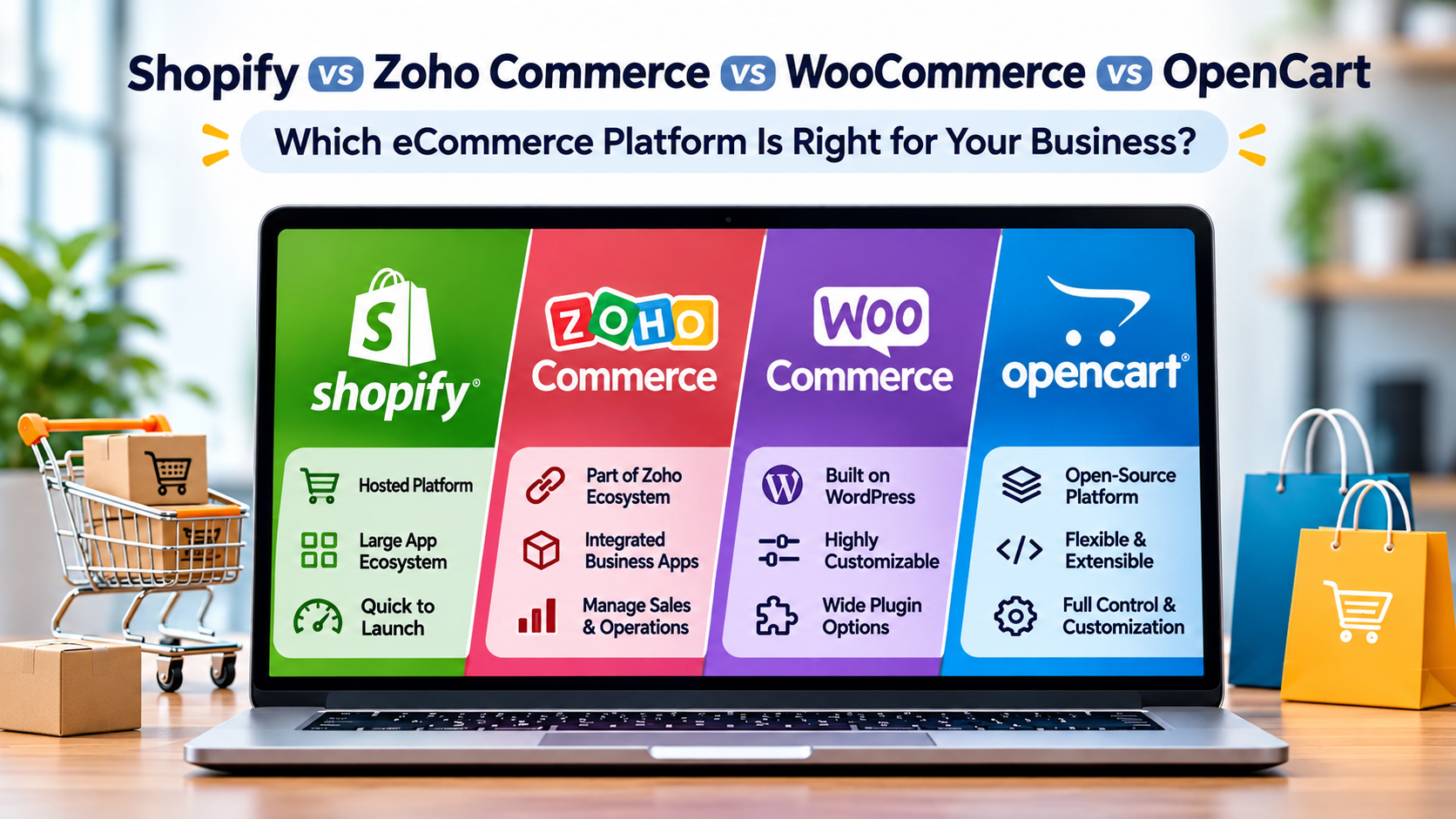
Four popular options worth considering are Shopify, Zoho Commerce, WooCommerce, and OpenCart.
Each platform offers a different approach to online selling. Some provide an integrated, hosted solution, while others offer greater control over hosting, customization, and technical implementation.
In this guide, we compare these four platforms to help you make an informed decision.
1. Shopify: A Dedicated Platform for Online Selling
Shopify is a hosted eCommerce platform designed to help businesses create, operate, and grow online stores.
It provides the main tools needed to manage an online store without having to manage the underlying web server or install the eCommerce software yourself.
Shopify is a good choice when your business needs:
-
A professional online store with ready-made themes.
-
Product, category, and inventory management.
-
Order processing and customer management.
-
Integrated shopping cart and checkout.
-
Payment gateway configuration.
-
Shipping and fulfillment options.
-
Marketing and promotional tools.
-
A wide ecosystem of third-party applications.
-
Multiple sales channels, including online and in-person selling.
Things to consider:
Shopify operates through subscription plans. Additional costs may include paid themes, applications, payment processing, and third-party transaction fees, depending on your configuration and location.
You should also evaluate the available payment providers and local shipping integrations before choosing Shopify.
Best suited for: Businesses that want a dedicated eCommerce platform with managed hosting, integrated store management, and a large application ecosystem.
2. Zoho Commerce: Online Selling Within the Zoho Ecosystem
Zoho Commerce is an eCommerce platform that enables businesses to build and manage online stores through a visual website builder and integrated store management tools.
One of its important advantages is its relationship with the wider Zoho ecosystem.
Businesses can connect their online selling activities with relevant Zoho applications, depending on their requirements and the integrations available.
Zoho Commerce is a good choice when your business needs:
-
A professional online store using visual design tools.
-
Product and category management.
-
Inventory and order management.
-
Shopping cart and checkout configuration.
-
Payment and shipping settings.
-
Promotional campaigns and discount management.
-
Store analytics and reporting.
-
Integration with Zoho business applications.
-
A connected environment for managing online sales and other business operations.
Things to consider:
Zoho Commerce provides a platform-based approach, so you should evaluate its available customization options, integrations, payment providers, and shipping capabilities against your specific requirements.
It is particularly worth considering when your business already uses Zoho applications or plans to adopt them.
Best suited for: Businesses looking for an integrated online store, particularly those that want to connect eCommerce activities with the Zoho business environment.
3. WooCommerce: eCommerce Built on WordPress
WooCommerce is an open-source eCommerce platform that operates as a WordPress plugin.
It transforms a WordPress website into an online store, allowing businesses to combine content management and eCommerce within the same website.
WooCommerce is a good choice when your business needs:
-
An online store built on WordPress.
-
Flexible website design and customization.
-
Product and inventory management.
-
Physical and digital product sales.
-
Shopping cart and checkout functionality.
-
Different payment gateway options.
-
Shipping and delivery integrations.
-
Marketing and SEO extensions.
-
Integration with a wide range of WordPress plugins and external services.
-
Greater control over website files, hosting, and store data.
Things to consider:
WooCommerce itself is free and open source, but operating a complete store involves hosting, a domain, security, backups, maintenance, and potentially paid themes, plugins, or development.
Your WordPress installation, WooCommerce plugin, and additional extensions must also be maintained and kept compatible.
Best suited for: Businesses that already use WordPress or need a highly customizable website combining content publishing and online selling.
4. OpenCart: An Open-Source eCommerce Platform
OpenCart is an open-source eCommerce platform developed specifically for building and managing online stores.
Unlike WooCommerce, which operates within WordPress, OpenCart provides its own store management environment.
It includes tools for managing products, categories, customers, orders, taxes, promotions, and reports.
OpenCart is a good choice when your business needs:
-
A dedicated eCommerce management system.
-
Product catalog and category management.
-
Customer and order management.
-
Multiple payment and shipping integrations.
-
Store themes and extensions.
-
Customization through development and additional modules.
-
Control over the hosting environment and software installation.
Things to consider:
The downloadable OpenCart software is open source, but running a complete store still involves hosting, configuration, security, backups, updates, and potentially paid extensions or custom development.
Businesses should also consider the technical resources required to maintain the platform and its extensions.
Best suited for: Businesses that prefer an independent open-source eCommerce platform and want greater control over its hosting, configuration, and customization.
5. Comparing the Four eCommerce Platforms
| Requirement | Shopify | Zoho Commerce | WooCommerce | OpenCart |
|---|---|---|---|---|
| Platform type | Hosted eCommerce | Hosted eCommerce | WordPress plugin | Open-source eCommerce |
| Hosting | Included | Included | Separate hosting | Separate hosting for self-hosted version |
| Product management | Yes | Yes | Yes | Yes |
| Order management | Yes | Yes | Yes | Yes |
| Inventory management | Yes | Yes | Yes | Yes |
| Themes and design | Themes and customization | Visual builder and themes | WordPress themes and customization | Themes and customization |
| Extensions | Shopify App Store | Platform integrations and available extensions | WordPress and WooCommerce extensions | OpenCart extensions |
| Customization | Within Shopify capabilities | Within Zoho Commerce capabilities | Extensive | Extensive through development |
| Zoho ecosystem | Through available integrations | Connected Zoho environment | Through available integrations | Through available integrations |
| Technical maintenance | Mostly platform-managed | Mostly platform-managed | Merchant or service provider | Merchant or service provider |
6. Which Platform Should Your Business Choose?
There is no single eCommerce platform that is ideal for every business.
The right choice depends on your business model, technical requirements, available resources, and future plans.
Here are some general recommendations:
Choose Shopify if:
-
You want a dedicated eCommerce platform.
-
You prefer managed hosting and platform maintenance.
-
You want access to a large application ecosystem.
-
You want to focus on selling rather than managing the technical infrastructure.
Choose Zoho Commerce if:
-
You already use Zoho applications.
-
You want to connect online selling with your business operations.
-
You prefer an integrated store management environment.
-
You want to manage your online store through Zoho’s platform.
Choose WooCommerce if:
-
You already have a WordPress website.
-
You need extensive customization options.
-
You want to combine blogging, content publishing, and eCommerce.
-
You prefer control over hosting and website data.
Choose OpenCart if:
-
You want a dedicated open-source eCommerce platform.
-
You prefer to control your hosting and technical environment.
-
You need a store that can be customized through extensions and development.
-
You have access to technical support for ongoing maintenance.
7. Important Considerations Before Choosing Your Platform
Before making your final decision, consider the following questions:
-
Business Model: Are you selling physical products, digital products, or both?
-
Product Catalog: How many products and product variations will your store contain?
-
Payments: Which payment gateways are available and suitable for your target market?
-
Shipping: Do you need integration with local or international shipping providers?
-
Inventory: Do you need to connect your online store with an existing inventory management system?
-
Accounting: Should online sales be connected to your accounting system?
-
Customization: Do you need standard store functionality or specialized business processes?
-
Technical Management: Who will manage hosting, updates, backups, and security?
-
Budget: Have you considered subscription fees, hosting, applications, extensions, development, and ongoing maintenance?
-
Future Growth: Will the platform support your expected business requirements as your store expands?
These questions help identify the right platform before investing time and money in implementation.
8. How Griffin Tech Can Help You Choose and Implement the Right Platform
At Griffin Tech, we understand that choosing an eCommerce platform is a business decision, not just a technical one.
Since 2014, we have been providing website design, development, hosting, and domain services.
Our experience includes working with different website and eCommerce platforms, helping businesses select the right solution based on their actual requirements.
Our eCommerce services include:
-
Shopify Store Design & Development.
-
Zoho Commerce Store Implementation.
-
WooCommerce Store Development.
-
OpenCart Store Development.
-
Product Catalog Setup.
-
Payment and Shipping Configuration.
-
Business Application Integrations.
-
Store Migration and Customization.
-
Ongoing Technical Support.
Our objective is to help you build an online store that supports your business operations and provides a convenient shopping experience for your customers.
Final Thoughts
Shopify, Zoho Commerce, WooCommerce, and OpenCart can all be used to build professional online stores, but they approach eCommerce differently.
Shopify focuses on a managed commerce platform. Zoho Commerce connects online selling with the Zoho business environment. WooCommerce extends WordPress into a flexible eCommerce solution. OpenCart provides an independent open-source platform for online stores.
The best choice is not necessarily the most popular or the least expensive platform.
It is the platform that matches your business requirements, operating model, technical resources, and long-term objectives.
Planning to launch an online store? Contact Griffin Tech and let us help you choose and implement the right eCommerce platform for your business.