
WordPress vs Joomla vs Zoho Sites: Which Platform Is Right for Your Business Website?
Choosing the Right Website Platform for Your Business
Building a corporate website is an important step in establishing your company’s online presence. But before choosing a design, selecting a hosting plan, or starting development, there is one important decision to make:
Which website platform is right for your business?
There are several platforms available, each offering different capabilities, levels of flexibility, and ways to manage your website.
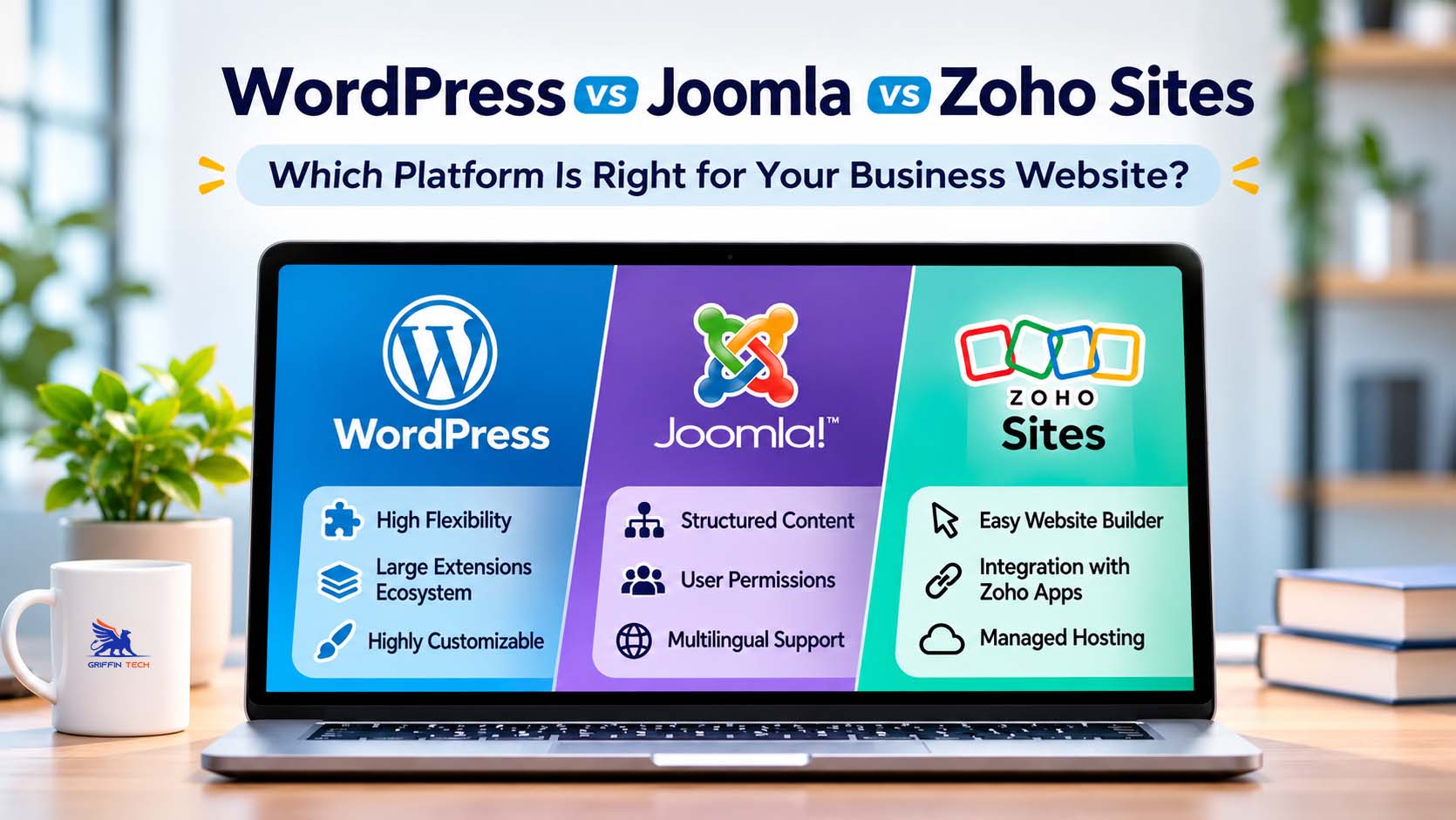
Three popular options for corporate websites are WordPress, Joomla, and Zoho Sites.
Although all three can be used to build professional business websites, they are designed around different approaches. Understanding these differences will help you choose a platform that fits your current requirements and future plans.
1. WordPress: Flexibility and a Wide Range of Extensions
WordPress is a widely used content management platform known for its flexibility and extensive ecosystem of themes and plugins.
It can be used to build everything from simple corporate websites to content-rich websites, business portals, and eCommerce stores.
WordPress is a good choice when your business needs:
-
A highly customizable website design.
-
A wide selection of themes and plugins.
-
Advanced website functionality through extensions.
-
Flexible content publishing and blogging.
-
Integration with different third-party services.
-
Room for future customization and development.
Things to consider:
WordPress flexibility comes with additional management responsibilities. Depending on the hosting and implementation approach, your business may need to consider software updates, plugin compatibility, security, backups, hosting, and ongoing maintenance.
Best suited for: Businesses that need flexibility, customization, and access to a broad ecosystem of website extensions.
2. Joomla: Structured Content and Advanced User Permissions
Joomla is an open-source content management system designed to manage websites with organized content structures and flexible user permissions.
It provides built-in capabilities for managing users, access levels, menus, and multilingual content.
Joomla is a good choice when your business needs:
-
Structured content management.
-
Different user groups and access permissions.
-
Multilingual website capabilities.
-
Flexible website organization and navigation.
-
Extensions to add specialized functionality.
-
A platform that can be customized as requirements evolve.
Things to consider:
Joomla may require a development team with platform-specific experience, particularly when implementing customized layouts, extensions, or advanced functionality. Like other self-hosted platforms, hosting, updates, backups, and maintenance should also be planned.
Best suited for: Businesses that need organized content management, more specialized access permissions, or multilingual website structures.
3. Zoho Sites: Simpler Website Management Within the Zoho Ecosystem
Zoho Sites is a website-building platform that allows businesses to create and manage websites using visual editing tools.
One of its main advantages is its connection with the wider Zoho ecosystem, making it a practical option for businesses that already use Zoho applications or plan to adopt them.
Zoho Sites is a good choice when your business needs:
-
A professional corporate website with visual editing tools.
-
Straightforward website content management.
-
Responsive website layouts.
-
Contact and inquiry forms.
-
Integration with supported Zoho applications.
-
Website lead collection connected to business processes.
-
A website management experience within the Zoho environment.
Things to consider:
Zoho Sites operates within the capabilities and extension options provided by its platform. Before choosing it, businesses should evaluate their requirements for custom functionality, external integrations, content management, and future development.
Best suited for: Businesses looking for a manageable corporate website, particularly when Zoho applications are already part of their business environment.
4. Comparing the Three Platforms
| Requirement | WordPress | Joomla | Zoho Sites |
|---|---|---|---|
| Website customization | Extensive | Flexible | Visual customization and supported code options |
| Themes and extensions | Large plugin and theme ecosystem | Extension ecosystem | Built-in tools and supported extensions |
| Content management | Flexible | Structured content management | Visual content management |
| User permissions | Roles and plugins | Built-in advanced access control | User and permission management |
| Multilingual websites | Supported through core features and extensions | Built-in multilingual capabilities | Depends on available platform features |
| Zoho application integration | Through available integrations | Through available integrations | Native integrations with supported Zoho apps |
| Hosting management | Depends on hosting setup | Depends on hosting setup | Hosting included in the platform |
5. Which Platform Should Your Business Choose?
There is no single platform that is the best choice for every business.
The right decision depends on what you want your website to do, how your team will manage it, and what you may need in the future.
Consider these general recommendations:
-
Choose WordPress if flexibility, customization, and a broad selection of extensions are your main priorities.
-
Choose Joomla if your website requires structured content management, more detailed access permissions, or built-in multilingual capabilities.
-
Choose Zoho Sites if you want a straightforward website-building experience and closer integration with Zoho business applications.
These are starting points, not strict limitations. All three platforms can support different types of corporate websites depending on their implementation.
6. Why Choosing the Platform Before Understanding Your Requirements Can Be a Mistake
A common mistake is selecting a website platform simply because it is popular or because another business is using it.
Before making a decision, consider:
-
What information and services will your website present?
-
Will your team regularly update website content?
-
Do you need multiple languages?
-
Will different employees need different access permissions?
-
Do you need integrations with CRM, accounting, or marketing applications?
-
Will your website need custom functionality in the future?
-
Who will manage hosting, updates, security, and maintenance?
Answering these questions first can help prevent unnecessary development costs and platform limitations later.
7. How Griffin Tech Can Help
At Griffin Tech, we believe that choosing the right technology starts with understanding the business.
Since 2014, we have been providing website design, development, hosting, and domain services.
Our approach is to understand your requirements, recommend a suitable platform, and implement a website that supports your business objectives.
Whether your project requires WordPress, Joomla, or Zoho Sites, we can help you through the planning, design, development, configuration, launch, and ongoing support stages.
Final Thoughts
Your corporate website should be more than an online brochure. It should represent your business professionally, communicate your services clearly, and support the way you work.
WordPress, Joomla, and Zoho Sites each offer a different approach to building and managing websites.
The best platform is the one that fits your business requirements today while giving you a practical path for future growth.
Not sure which platform is right for your business? Contact Griffin Tech and let us help you make the right decision.